Escaping viennese high fog
Especially in autumn and early winter, the fog can be very persistent over the Vienna Basin. The days of dreary weather often affect people's moods, and the longing for sunshine becomes strong. But which of the surrounding mountains is suitable for a hike above the fog? This analysis aims to provide a statistical answer to this question.
Filtering of high fog days
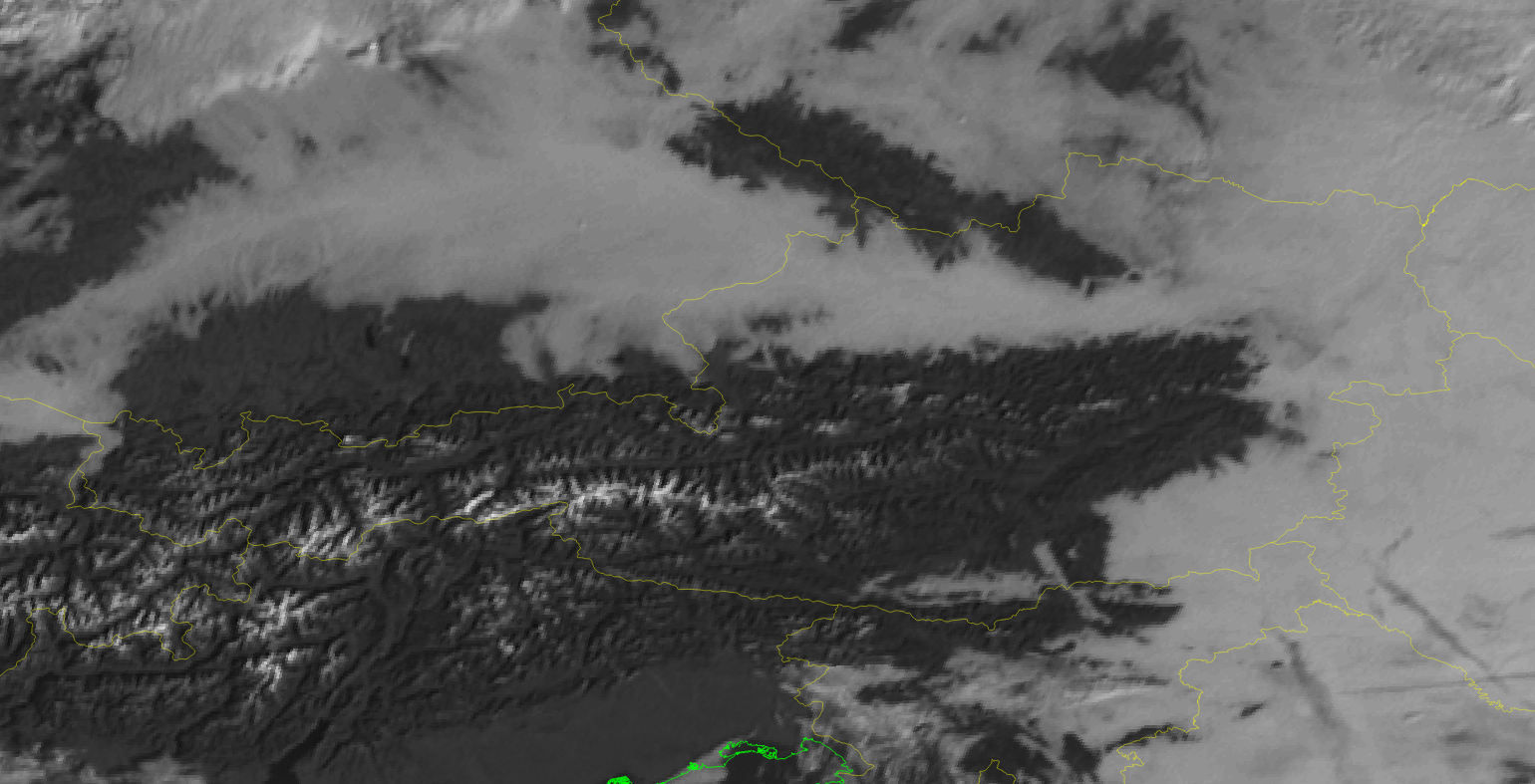
At the beginning of this analysis, days with high fog over Vienna must be defined and filtered. In stage 2, the frequency with which the sun appears on the surrounding peaks and popular hiking destinations on these days is evaluated. An example of such a high fog day over Vienna is November 27, 2020, on which the satellite image below (Figure 1.1) was taken.
Data
The SYNOP data are ideal for this analysis. This dataset is particularly suitable for questions where the answer also relies on observational parameters. For this case study, the following two parameters from the SYNOP dataset of the Vienna-Hohe Warte station for the years 2011 to 2020 are downloaded from the GeoSphere Austria data portal:
- Ns1 - Coverage of the lowest cloud layer
- h - Height of the lowest clouds
These parameters are not directly transmitted in SYNOP data, but are subject to an internationally standardized coding system. An explanation can be downloaded from the abstract of the SYNOP Dataset (Synop Sheet 1 and Synop Sheet 2). For example, if the parameter h has a value of 3, a cloud base of 200 m to 300 m will be observed at the observation date; the key number 4 represents 300 m to 600 m, and the number 5 represents 600 m to 1000 m. For the parameter Ns1, the digits 0 to 8 indicate the cloud cover in eighths. Key number 9 means "sky not visible".
Methods
To classify a day as a high fog day, the following two conditions were established using the downloaded data:
1) Daily mean (Ns1) >= 7/8
2) Daily maximum (h) <= 4 (cloud base 300 m to 600 m above ground)
Based on these assumptions only those days are selected on which a nearly continuous cloud cover persists for most of the day at a maximum altitude of 600 m above ground. In the period from January 1, 2011, to December 31, 2020, 126 high fog days occurred according to this filter, which corresponds to an average of 12.6 high fog days per year. It should be noted that the applied filter is very strict and allows almost exclusively continuously overcast days with only very brief breaks in the cloud cover. The perceived number of annual days with high fog may be higher than accounted for by these threshold values, due to overcast mornings followed by sunnier afternoons or afternoons accompanied by higher-altitude clouds.
Appendix / Images
Combination with sunshine duration data
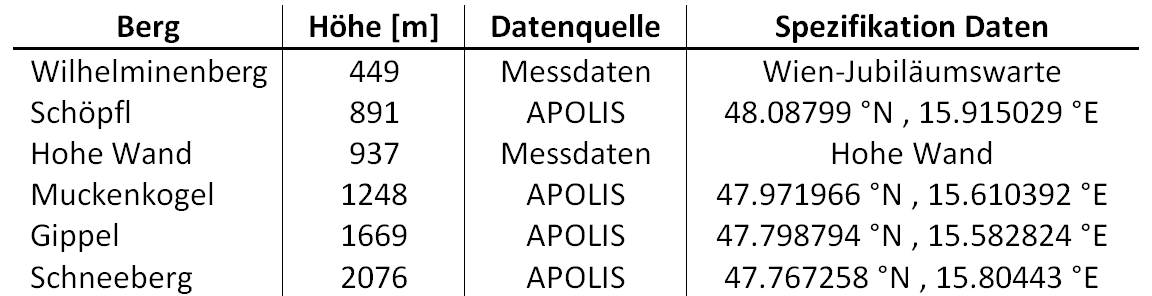
The high fog days filtered from level 1 will now be correlated with sunshine measurements. For this purpose, the measuring stations at the Jubiläumswarte on Wilhelminenberg in western Vienna (449 m above sea level) and on the Hohe Wand near the Hochkogelhaus (937 m) will be used. To obtain robust and more comprehensive statistics, calculated values from the APOLIS short-term dataset will also be accessed in addition to the measured data. Here grid point time series with daily resolution will be downloaded from the following locations:
- Schöpfel, at 891 m the highest mountain in the Vienna Woods
- Muckenkogel, located above Lilienfeld and at 1248 m high
- Gippel, located in the Mürzsteg Alps and at approximately 1669 m high
- Schneeberg, the highest mountain in Lower Austria at 2076 m high
Table 2.1 summarizes the locations from measurements and APOLIS data. The parameter "sunshine duration" is retrieved from the measurements as well as APOLIS data at daily resolution.
Analysis of sunshine duration
In the next step, the 126 days of high fog over Vienna from step 1 are examined on the individual mountains. If a sunshine duration of at least two hours is registered on one of these days, then that day is classified as being outside the high fog zone.
Results
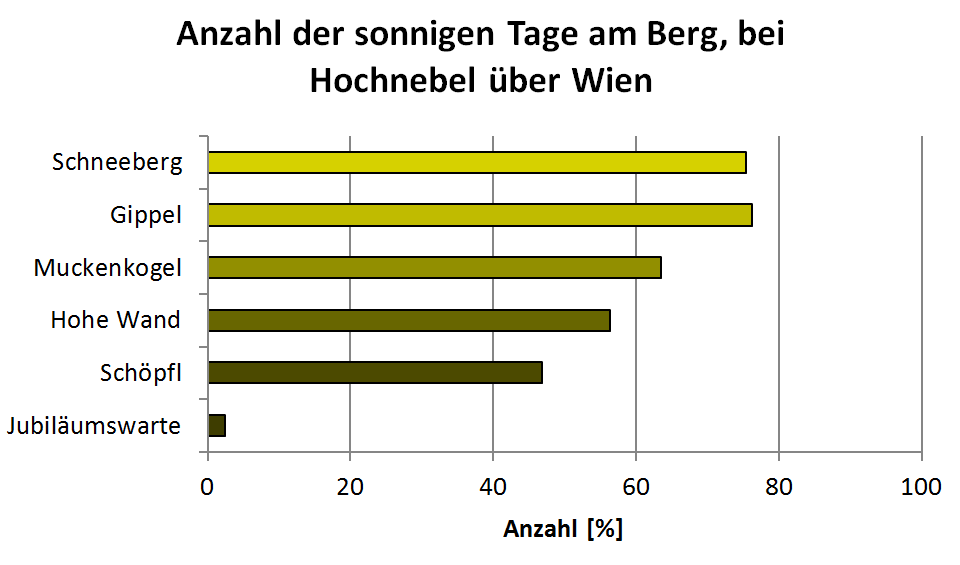
Figure 2.1 shows the results of this analysis. Unsurprisingly, the altitude of the mountains under consideration plays a crucial role. The higher the location, the more likely it is that it will rise above the high fog and record the minimum of two hours of sunshine. The Wilhelminenberg in Vienna, with its Jubiläumswarte (Jubilee Observation Tower), is the least eligible for escaping viennese high fog in this analysis. On average, the sun shines for at least two hours on approximately 2.4% of the days in Vienna characterized by high fog.
Surprisingly, the top spot belongs to the second highest mountain (the Gippel at 1669 m), and it shares this position almost equally with the Schneeberg. A likely reason for this is that the high fog rarely reaches a thickness that extends above the Gippel. However, potential dynamic factors should also be considered.
High fog tends to form over Vienna when wind is approaching from the southeast. However, with precisely this wind direction, the Gippel mountain is already in the lee of the higher mountains Schneeberg, Rax, or Hochschwab. This may lead to drying or better mixing at the upper edge of an inversion, reducing the cloud ceiling above the Gippel.
In summary, the mountains in or directly around Vienna are rarely sufficient to escape the high fog. However, the chances increase significantly with altitude. The Schneeberg, in particular, with its cog railway, is a good tip for catching some sunshine on an autumnal day in Vienna shrouded in high fog.
A more precise analysis of this question could be established with radiosonde data. Inversions, which are primarily responsible for high fog, and their upper limits can be clearly identified in the weather balloon ascents.
Appendix / Images
Datasets
Dieser Datensatz beinhaltet Tages- und Terminwerte einer Vielzahl meteorologischer bzw. klimatologischer Parameter. Die drei Klima-Beobachtungstermine (I, II, III) haben sich in Österreich im Laufe der Zeit verändert. Bis 1971 wurden die Klima-...
Temperature, Humidity, Radiation, Wind, Precipitation, Cloud cover, Pressure, Snow, Sunshine, Visibility, Observed weather phenomena, Thunderstorm
