Weather statistics for a specific day of the year
Certain occasions are often associated with preferred weather conditions. While an outdoor celebration usually calls for sunny, dry weather, an autumn hike might benefit from wisps of fog in the valley below, lending the landscape a touch of mystery. The occurrence of these and many other weather conditions is linked to a seasonal frequency, which will be analyzed using an example in this showcase. What all difficulty levels have in common is that they rely exclusively on past data and do not allow for any predictions about the future. The example location and date will be May 1st in Bad Gleichenberg.
Precipitation on May 1st
Precipitation plays an important role in many planning processes. However, before determining the average amount of precipitation, it is necessary to filter on how many May 1st it actually rained.
Data
For this purpose, daily data between 2003 and 2021 is downloaded from the GeoSphere Austria data portal, where the parameter "nied" – total precipitation – is significant. If this parameter has a value of -1, it is a May 1st without precipitation. If it has a value of 0, it indicates traces of precipitation, which refers to situations where precipitation is recorded, but the total amount is below the measurable threshold of 0.1 mm. All other numerical values represent the total daily precipitation in mm.
Results
In order to evaluate if there was precipitation on any given day at the Bad Gleichenberg station focus is only given to whether or not the parameter has a value of -1. The actual amount of precipitation is irrelevant.
Out of the 19 years (2003 to 2021), it rained on May 1st in 12 years. This corresponds to a precipitation probability of approximately 63%. For comparison: On October 1st, it did not rain in 13 out of 19 years, which corresponds to a rain probability of approximately 32%.
To determine the average rainfall, it makes sense to first filter out the days without precipitation from the data. This results in an overall average rainfall of approximately 5.2 mm on May 1st, assuming it is one of the 63% of May 1st on which precipitation actually falls. Between 2003 and 2021, the rainfall record in Bad Gleichenberg fell on May 1st with 31.9 mm in 2016.
Temperature Analysis
Air temperature can be of particular interest for any activity. Here the minimum, maximum and average air temperature shall be examined.
Data
For this analysis the same dataset as in step 1 is employed. The parameters required are tmin and tmax (i.e. minimum and maximum air temperature between 7 PM CET of the previous day and 7 PM CET of the current day) as well as t (mean temperature).
Results
For clarity, the results are presented in a table 2.1. While the columns contain the meteorological parameters, the rows contain the statistically evaluated key values.
In Bad Gleichenberg, the average temperature on May 1st is around 15 °C. The highest temperature recorded on this day in the period from 2003 to 2021 is over 29 °C, which is significantly higher than the average daily maximum of around 21 °C. Frost is considered very unlikely, as the lowest recorded temperature has been over 4 °C.
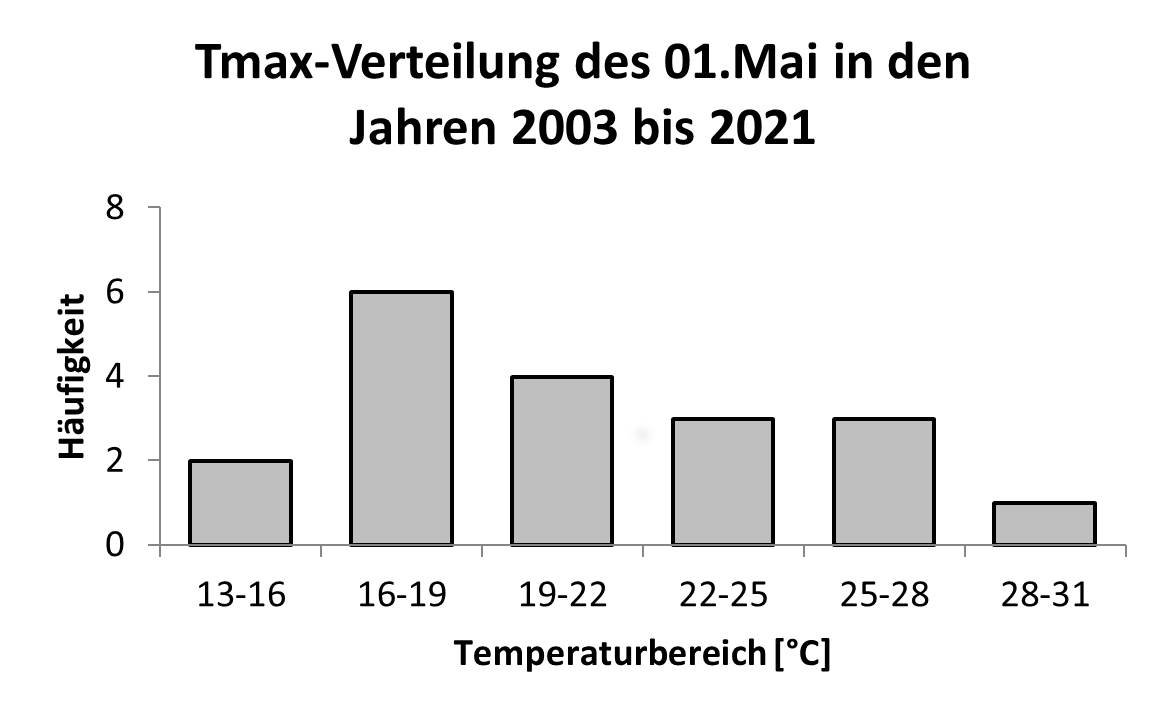
These distributions can also be visualized as a histogram. Figure 2.1 shows such an analysis for the measured maximum temperatures. Both the data analysis and the graphical representation were performed using Microsoft Excel.
Appendix / Images

Datasets
Dieser Datensatz beinhaltet Tages- und Terminwerte einer Vielzahl meteorologischer bzw. klimatologischer Parameter. Die drei Klima-Beobachtungstermine (I, II, III) haben sich in Österreich im Laufe der Zeit verändert. Bis 1971 wurden die Klima-...
Temperature, Humidity, Radiation, Wind, Precipitation, Cloud cover, Pressure, Snow, Sunshine, Visibility, Observed weather phenomena, Thunderstorm
